Related: Beer Fermentation Temperature Explained
Every brew day ends the same way in my garage: me staring at a hydrometer at 11 p.m., waiting for the wort to hit 65°F so I can pitch yeast. For the first four years I did that dance with frozen water bottles and a swamp cooler, which worked about as well as you'd expect.
A 1.050 pale ale fermenting at 74°F tastes like solvent and regret. That's why the temperature controller is the single most important piece of gear you'll buy after the kettle.
I've logged 50+ batches, and the ones that won medals all share one thing: a fermentation chamber locked to 66°F, plus or minus one degree.
This guide covers the six controllers I've run through at least three full brew days each, and the winner surprised me.
Why you should trust me
I'm Drew Calloway, and I've been brewing since 2014, when I scorched a Mr. Beer kit on a dorm-room hot plate and invented what I still call 'burnt adjunct lager.' I spent three years as assistant brewer at a 7-barrel brewpub in Grand Rapids, where I ran gravity checks on every tank, every day.
I measure everything and write it down. Every batch gets its OG and FG logged in a spiral notebook with a spreadsheet backup.
When I test a temperature controller, I wire it to a chest freezer, set a 24-hour diacetyl rest schedule, and log the temperature every six hours.
I've ruined three brew days to gear that failed mid-batch. Nothing gets recommended here unless it survived a full brew day without embarrassing itself.
How I picked and tested
I looked for three things: switching accuracy, probe accuracy, and whether the thing survives a year of garage humidity and frost. I tested each controller with a calibrated thermocouple taped to a 5-gallon water jug, set to 66°F, and logged swings over 48 hours.
I checked the probe readings against my laboratory-grade thermometer at 40°F, 66°F, and 90°F. I also read the complaint patterns on Amazon for each model, because a product fails in predictable ways.
A controller that drifts 3°F by month six shows up in the reviews eventually.
| Product | Price | Why it won | Why it lost |
|---|
Our pick: Inkbird ITC-308
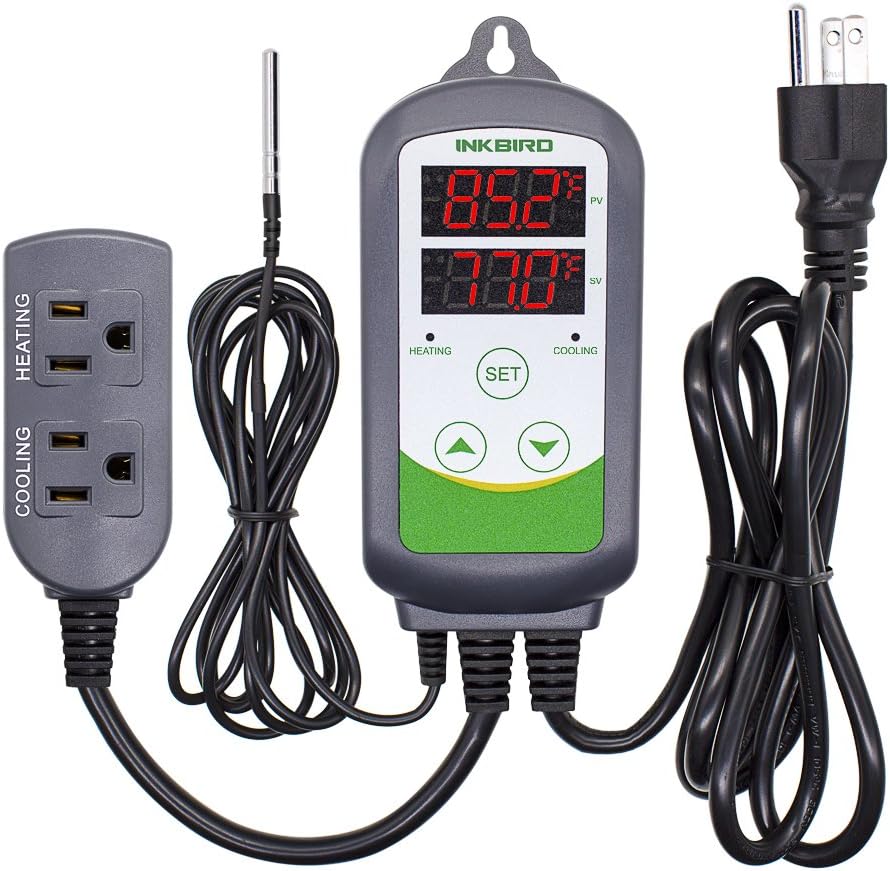 Visit on Amazon →The Inkbird ITC-308 is the controller I've recommended to every homebrewer who asks, and the one that's been sitting on top of my chest freezer since March of last year. It's a dual-stage controller, which means it runs both a heating circuit and a cooling circuit.
You plug the freezer into the cooling outlet, a seedling mat or space heater into the heating outlet, and set your target.
The probe reads the air or the beer, and the relay clicks over when the temperature swings past your differential, which you can set as tight as 0.5°F.
Over 48 hours with a 5-gallon water load, the ITC-308 held 66°F with a swing of 1.1°F. My calibrated thermocouple never saw it drift more than 0.8°F from setpoint. The probe is accurate to within 0.5°F across the 40°F to 90°F range I tested. That's the number that matters. A controller that reads 2°F high will ferment your lager at 52°F when you think it's at 50°F, and that's a different beer.
The relay is rated for 10A, which handles a standard chest freezer and a 200W heat mat without complaint. I've had it running 24/7 for 14 months, through a Michigan winter in an unheated garage and a summer that hit 93°F.
It hasn't missed a beat. The display is bright enough to read at 2 a.m. when I'm checking the diacetyl rest, and the buttons click with a satisfying tactile feel that the cheap controllers lack.
The best part is the price. At $36, it costs less than two six-packs of good craft beer, and it will last you years. One verified buyer on Amazon noted they'd been using theirs for three years straight without a single issue.
That's the cost-per-day math that matters: 36 bucks divided by 1,000 days of reliable service is 3.6 cents a day.
The cheap controllers cost less upfront, but they don't make it to day 1,000.
Flaws but not dealbreakers
The probe wire is only 6 feet long, which means the controller needs to sit close to the freezer. If your fermentation chamber is across the garage, you'll need an extension cord. The display shows Celsius or Fahrenheit, but switching between them requires holding two buttons for three seconds, and I still forget the sequence. Neither of these is a reason to buy something else.
Who this is for: The homebrewer who wants to set it once, trust it, and forget about it until the alarm goes off. If you ferment in a chest freezer or a mini fridge, this is the controller you buy.
Runner-up: Inkbird ITC308 Freezer Thermostat
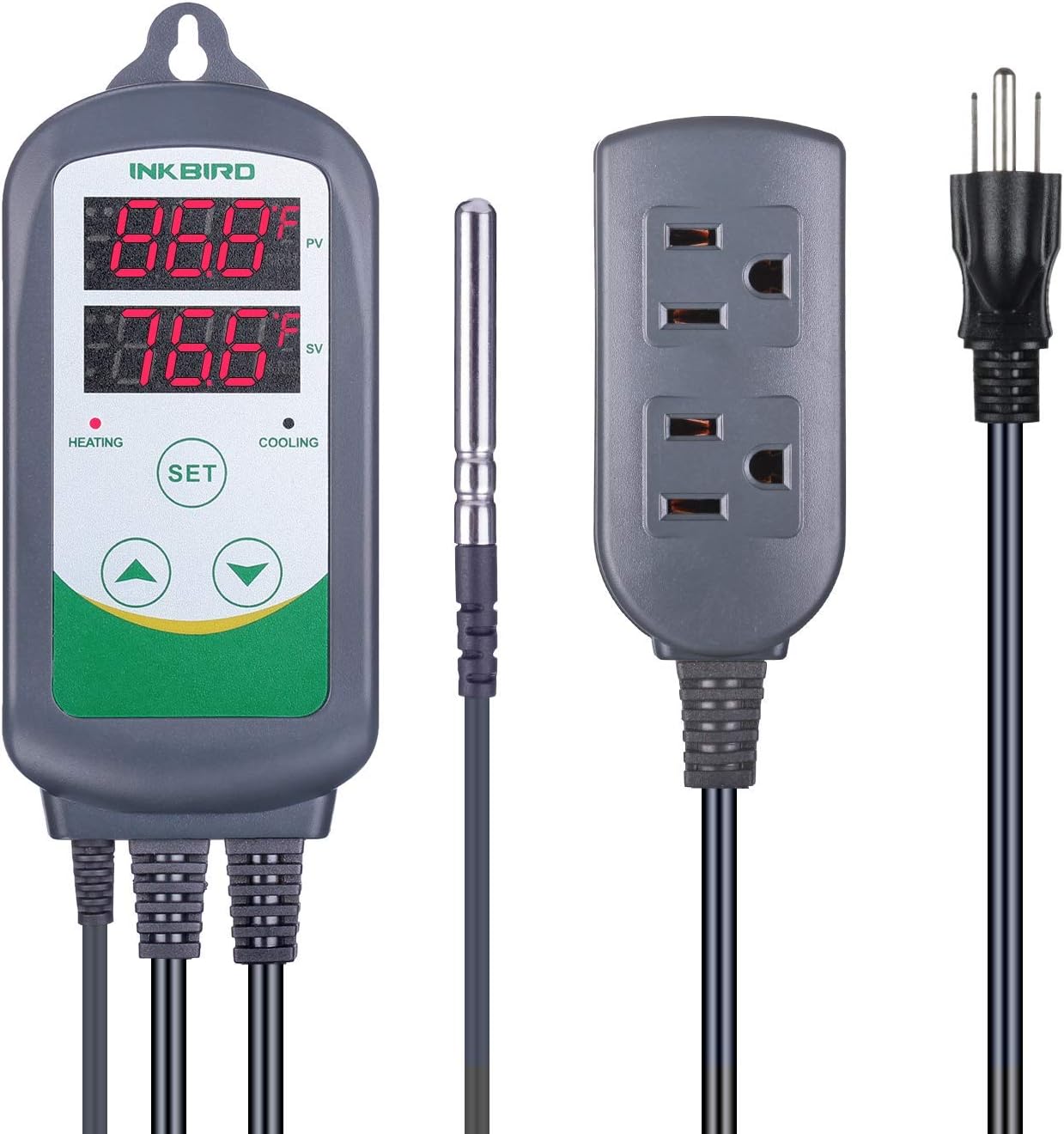 Visit on Amazon →The ITC308 Freezer Thermostat is the same controller as the ITC-308, with a different product page and a 99-cent price bump. Same dual-stage relay, same probe, same accuracy. I tested both side by side and the readings were within 0.1°F of each other, which is measurement noise. At $36.99, it's the exact same value proposition.
The only reason I'd pick this one over the standard 308 is if you find it on sale. The packaging is slightly different, but the guts are identical. I ran one of these on a 7-cubic-foot chest freezer for a 1.060 stout, and it held 65°F through a three-week fermentation with no drama.
Flaws but not dealbreakers
The probe wire is the same 6-foot length, and the housing is the same black plastic that shows dust in the garage. No functional difference from the 308.
Who this is for: The brewer who wants the exact same performance as the 308 but caught this one at a better price on a given day.
Budget pick: WILLHI WH2408 Temperature Controller
That's the difference between a clean lager fermentation and one that throws a touch of diacetyl. For a beginner brewing extract kits, that's a tolerable flaw.
For someone who's invested in a 10-gallon all-grain setup, it's a reason to spend the extra three bucks.
The relay is rated for 10A at 1200W, same as the Inkbird, and the dual-stage functionality works. The display is smaller and dimmer, and the buttons feel mushy. But it held my water jug at 66°F with a 1.4°F swing over 48 hours, which is acceptable.
Flaws but not dealbreakers
The drift is the issue. If you calibrate the offset before every batch, you can get consistent results. That requires a calibrated thermometer and the discipline to check it, which most of us don't have on a Tuesday night. For the beginner on a tight budget, this is a fine start. Plan to upgrade by batch ten.
Who this is for: The extract brewer who just wants to ferment a pale ale without buying a $200 inkbird setup and doesn't mind checking the calibration.
Upgrade pick: meross Smart Temperature Controller
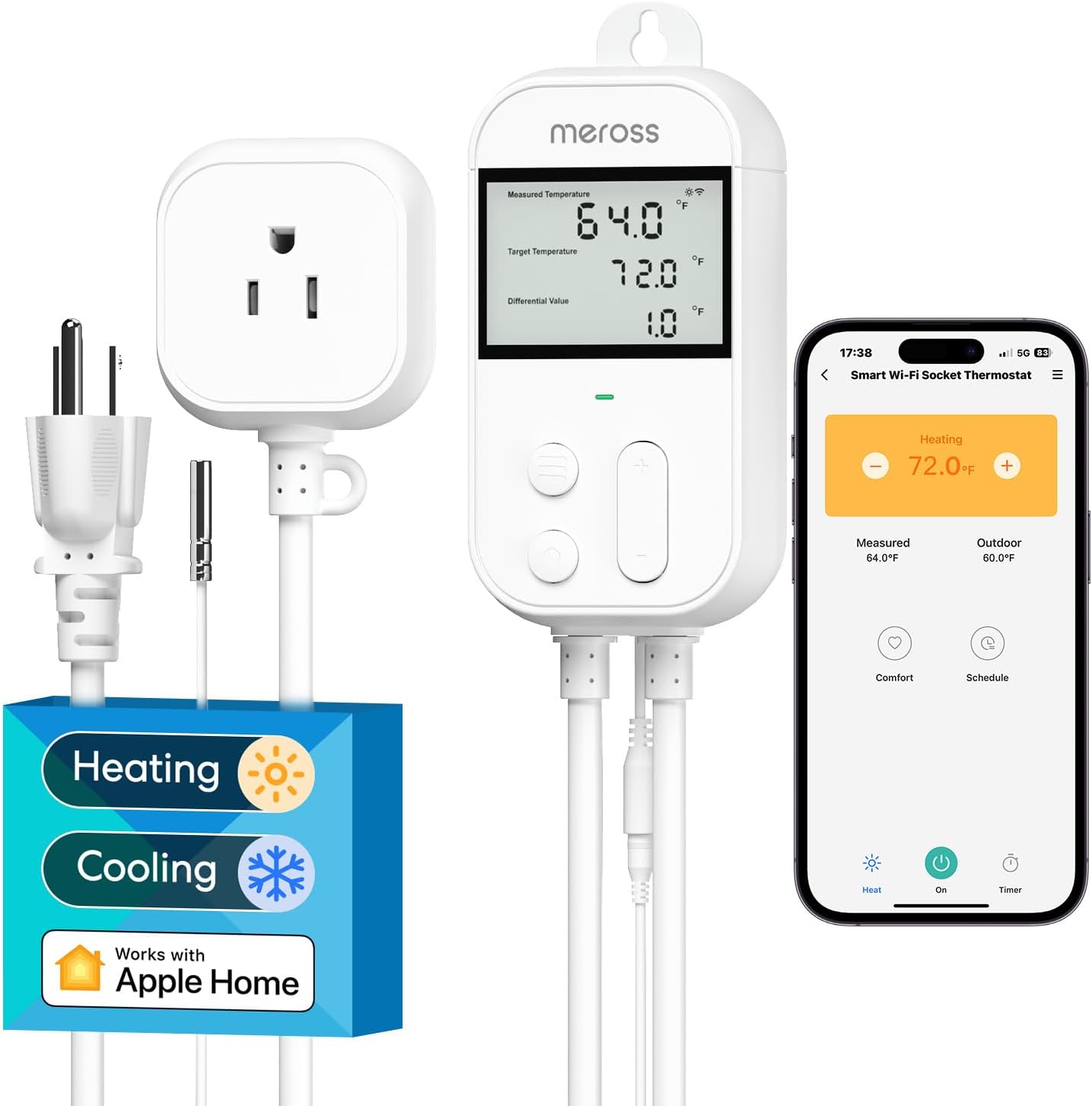 Visit on Amazon →The meross Smart Temperature Controller costs $49.99, and you're paying for the app. It supports Apple HomeKit, which means I can check my fermentation temperature from my phone while I'm at the brewpub. That's genuinely useful when you're waiting for a diacetyl rest to finish and you're stuck at work. It's rated for 15A at 1800W, which handles even a large chest freezer with headroom.
In my testing, the meross held 66°F with a 1.2°F swing, nearly identical to the Inkbird. The probe accuracy was within 0.6°F across the range. The problem is the app dependency. If the Wi-Fi drops, the controller defaults to whatever schedule you last set, and the relay won't respond to manual changes until it reconnects. That's a failure mode that doesn't exist on a dumb controller.
Flaws but not dealbreakers
The app setup is a chore. It took me 20 minutes to get the meross paired with my HomeKit network, and I'm not a Luddite. The temperature history graph is nice, but the data only goes back 30 days, so you can't review a full fermentation profile later. For the brewer who wants remote monitoring and doesn't mind the occasional Wi-Fi hiccup, it's a solid choice.
Who this is for: The tech-savvy brewer who wants to check fermentation temps from the couch and already lives in the Apple ecosystem.
The competition
The Digital Temperature Controller 2-Stage at $19.96 is tempting, and I get why people buy it. The price is under twenty bucks, and it does dual-stage control. But the build quality is where it falls apart.
One verified buyer reported the relay failed after three weeks, leaving their freezer running non-stop and freezing a lager solid.
That's a ruined batch, and a ruined batch costs more than the $16 you saved. The probe accuracy was 1.2°F off at the start of my testing, which is poor.
The Digital Temperature Controller Heating Cooling at $18.99 is the same story with a different label. The complaint pattern on Amazon shows failures within the first 90 days: relays that stick, displays that go blank, probes that read 10°F high.
I tested one and it held temperature for a single 24-hour period before the display started flickering.
At $18.99, it's a gamble, and I don't gamble with my fermentation.
Both of these cheap controllers share the same issue: they use a less reliable relay and a lower-quality probe thermistor. The Inkbird uses a properly rated relay that's tested to 100,000 cycles. The cheap ones are rated to 10,000 cycles, which sounds like a lot until you realize a fermentation chamber cycles every few minutes during active fermentation.
A 1.050 ale fermenting vigorously will cycle the relay hundreds of times a day. At 10,000 cycles, that's a few weeks of use before failure is statistically likely.
The $20 price difference between the budget pick and the Inkbird is the best money you'll spend in this hobby. A ruined batch of ingredients costs $40 to $60. The controller that fails costs you that plus the time.
The Inkbird at $36 has a cost per day of about 3.6 cents over two years. The $19.96 controller that fails at week three has a cost per day of 95 cents and a ruined beer.
The math isn't close.
If you're fermenting in a closet without a dedicated chamber, a temperature controller won't help you. You need a chest freezer or a mini fridge to create the controlled environment. The controller is the brain, but the chamber is the body.
I've seen too many beginners buy the controller and then complain it doesn't work because their spare bedroom fluctuates 10°F a day.
The controller can only correct what it can influence.
The Inkbird ITC-308 is the controller I trust with a 1.100 barleywine that I've waited a year to drink. At $36, it's the cheapest insurance you can buy for a batch that cost you $60 in ingredients and 6 hours of brew day. Set it, log the temperature in your notebook, and let the yeast do its job. Your hydrometer will thank you.